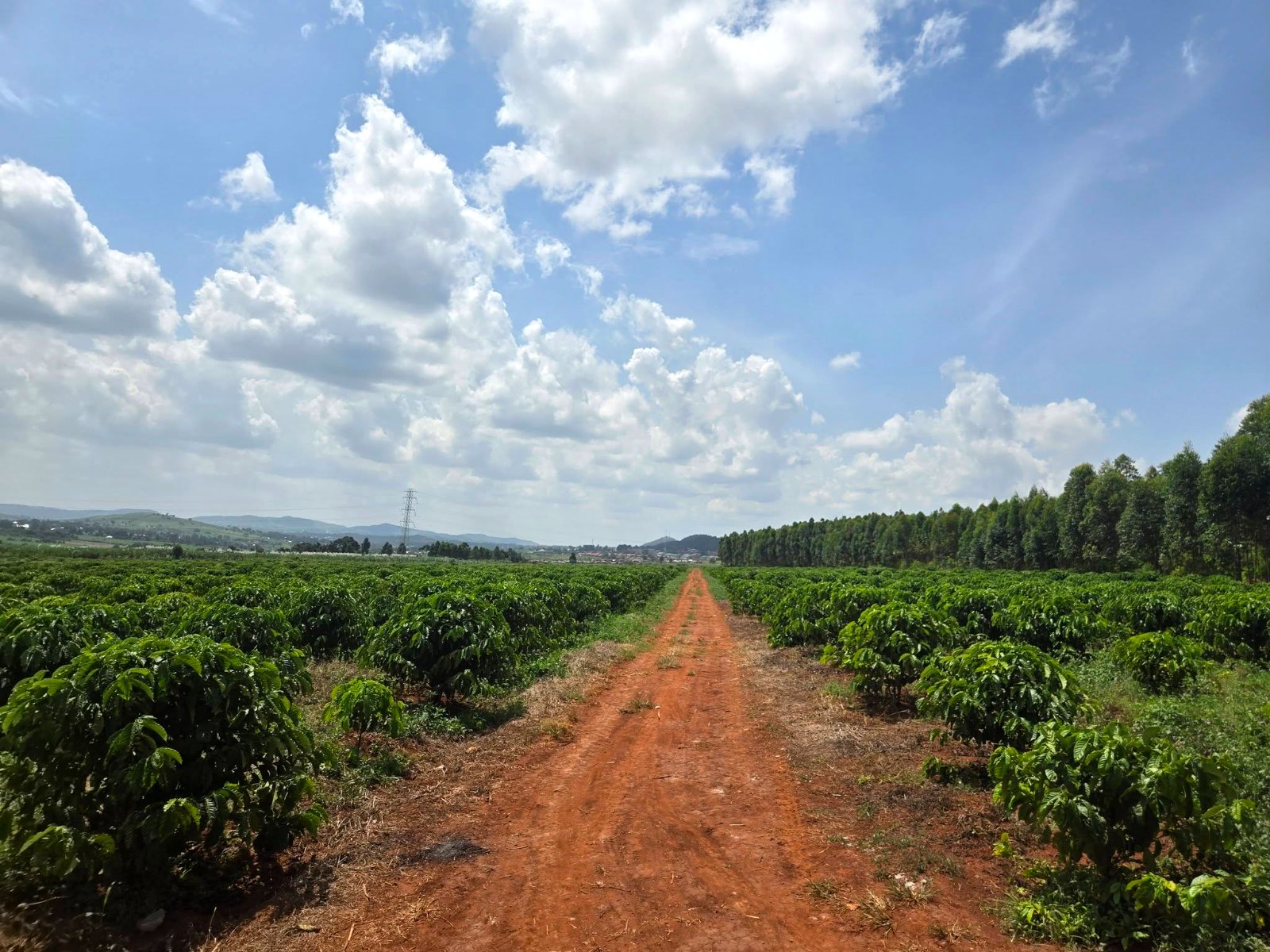
The Farm at Wairasa, Mayuge District, Eastern Uganda
Currently in the ground.
31,000 coffee trees and 8,000 cocoa trees planted in phase one. Nine coffee blocks and four cocoa blocks across 88 acres at Wairasa, worked by twelve permanent staff on site year-round.
Photographs and field notes from the estate as it grows. We are just getting started, and this section will grow over time.
From the Desk
Field notes from Thena Estates by Nelson Kituuka.
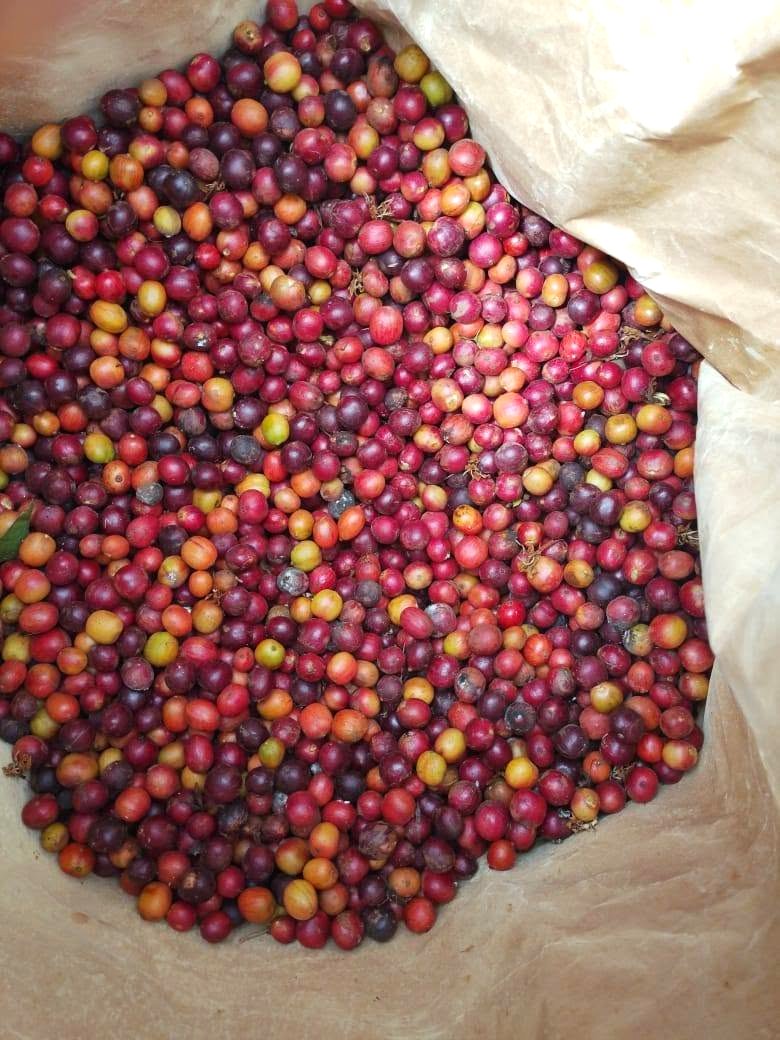
Cherry and Flower Season
· By Nelson Kituuka
There are so many fly by wire tenderpreneurs coming into our business, but eventually they will also have to do the work we have done.


Oversight
· By Nelson Kituuka
One of the most underrated parts of management is oversight.
You need to have eyes at the back of your head when running an enterprise.
I keep telling my staff that I will believe and take your word that you are telling me the truth. However, I will always endeavour to verify that what you said lines up with other control measures I have put in place.
That is when even small things, like surveillance that clocks the weight reading of items entering and leaving the solar dryer, become useful.
As management you should never shy away from crosschecking even simple things like the arithmetic or the small numbers. Those small checks normally spring leaks and surprises that, if not dealt with, will sink big ships.


Depth of Vision
· By Nelson Kituuka
We need to train our next generation of entrepreneurs to have depth of vision.
Yesterday when our consultant was moving around the farm he made one fundamental comment that has stuck with me.
It is not planting or harvesting that matters in agriculture. It is that crucial part in between which determines yield.
To maximise yield you need a schedule of maintenance that maximises nutrient uptake by the plants and fights all the vagaries and pests that attack it. For cocoa, for example, you need to spray it every month just to keep the pests and disease at bay.
One of the reasons I post these stories on this platform is to show that the journey isn't straightforward. So many hurdles and obstacles are thrown your way, but if you have depth of vision and see that at one point you will have a forest, you persevere and stick with it against whatever and whomever comes at you.
This journey makes you focus on building foundations to last. Short-term fluctuations in market prices, or weather patterns that are out of sync, should not make you waver if eventually the math will math. You need to be able to take direct financial hits for a minimum of 3 years and keep pushing along regardless to tame this tiger.
The last thing that this journey is teaching us is to learn how to utilise every square inch of land at your disposal, and make sure you don't discard anything that comes from the garden or falls in the garden as a result of your activity. There is a way they can all be turned into liquidity if you put some thought to it.
See the forest.
Solar Drying
· By Nelson Kituuka
Day one.
We need to figure out how to use this.


Locked and Loaded
· By Nelson Kituuka
We are aware El Niño is knocking on the door.
We will plant as much as we can and see what sprouts and what doesn't.
This time around we have used inorganic fertiliser as well, so as to compare performance and see if there is a direct correlation between its use and growth in yield.
Ultimately what we hope is that even if the intercrops don't yield as much as anticipated, we will improve the overall soil health, which should work for the main crops.
We are trying as much as possible to squeeze utility out of every inch of land we plant, so that we get some level of profitability one way or another.
There comes a time when you give it your best shot and then wait and see what happens. Win or lose, lessons for the future will be learnt and documented so we are better prepared for the next round of battle.
These days, surprisingly, doing practical things intrigues me more than using AI to solve perceived problems.
My hypothesis is that there are many things raw intelligence can help you accomplish, but nothing beats battlefield knowledge in a world which has more than its fair share of armchair experts with no knowledge of what the real terrain on the ground is.


Next to Done
· By Nelson Kituuka
So one thing we didn't count on when planning the drying, or say post-harvest handling, of coffee was this little-discussed issue.
Coffee absorbs all sorts of scents and smells that are around it, and that is later infused into its taste.
So on the advice of experts we were told to move the coffee to as remote a location as possible, so that waragi, smoke or car fumes would not get to it during the drying process, and the coffee would taste as natural as possible.
We were also told that even the metallic nets that support the drying beds or benches could be a source of a scent that could change the taste or cup quality of the final roast. So we were advised to use red eucalyptus wood for the benches, as it is said to be one of the most neutral woods for the job.
Also worth noting: no preservatives like varnish or paint should be used on the structure, as those too have the same effect on the coffee.
The things you learn along this journey.
On to the next.

The Quiet Part
· By Nelson Kituuka
A lot is said about farming and what you should do first.
Many start with talking about securing land ownership, irrigation, setting up boundaries and putting up support structures and infrastructure.
In our experience, all of the above won't matter if what you are going to grow on the land doesn't germinate and survive.
If you want to go into agriculture, in my view the most crucial exercise is taming the land.
Taming the land is getting it from whatever it was used for previously into a state in which whatever you grow on it will first germinate and, if successful at that, will then grow.
If whatever you are planning to grow doesn't germinate, then all that pre-entry activity will be for naught.
A lot is said about laying out plans before going in. But all those plans will yield nothing if the plants do not germinate. So my take is: start by taming the land, and then, as you get results from those activities, lay out your plans.
Our consultant, on day one of meeting him, asked to see “the patient”, referring to the land, even before agreeing to work with us or discussing anything about what we wanted to do. His first role was to see, from his vast experience, if the land was tameable before engaging.
After examining “the patient”, everything else was discussed and subsequently implemented. The part I didn't appreciate at that point was when he mentioned that by seeing what has been growing on the land previously, you can determine what will grow going forward.
If you find an area which grows just grass and a few shrubs, it is pushing your luck to plant hardwood trees. If they could survive, they would be there naturally, or there would be signs that they can survive there.
If you won't be able to tame the land, look for someplace else to carry out what you were hoping.


What coffee does Thena Estates grow and how is it processed?
Robusta variety in Mayuge district, Jinja, selected for yield consistency, disease resistance, and suitability to Eastern Uganda's conditions. The coffee is sun-dried natural process, producing a full-bodied, sweet-finish cup available from the 2026 harvest.
What is sun-dried natural Robusta?
Sun-dried natural means the whole coffee cherry is dried intact with the fruit pulp still surrounding the bean, transferring fruit sugars during drying and producing a naturally sweeter, fuller-bodied cup. Thena Estates manages this process on-farm, controlling drying time and moisture levels to ensure consistent quality across each harvest.
What is the Busoga region and where exactly is Thena Estates located?
Thena Estates is located at Wairasa, Mayuge District, in the Busoga region of Eastern Uganda, just off the Jinja-Iganga highway at Wandago. The estate sits within the Lake Victoria basin, approximately 80km east of Kampala and close to Jinja, Uganda's second city and the source of the Nile.
What makes Busoga soil and climate ideal for growing Robusta coffee?
The Lake Victoria basin receives rainfall approximately 70 percent of the year, with two reliable rain seasons, consistent equatorial temperatures, and deep volcanic soil that produces dense, high-quality Robusta cherry. These are the natural conditions under which wild Robusta grew in this region for centuries.
Is Thena Estates coffee traceable and suitable for EUDR compliance?
Thena Estates is building full digital traceability from tree to export, with GPS-tagged trees, mapped blocks, and digital records documenting every tree, every input, and every harvest. This infrastructure is designed to meet the requirements of the EU Deforestation Regulation and the needs of roasters who require verified, origin-specific documentation.
Where is Uganda coffee grown?
Thena Estates coffee is grown at Wairasa, Mayuge District, in the Busoga region of Eastern Uganda, within the Lake Victoria basin just off the Jinja-Iganga highway.
How is Uganda cocoa grown?
Thena Estates grows fine flavor cocoa alongside its coffee at Mayuge, managed under the same block-level agronomic discipline, for quality and long-term sustainability.
Wairasa, Mayuge District, Eastern Uganda
Email: info@lexi.co.ug
Phone and WhatsApp: +256 769 513 824
Instagram · Google Maps
© 2026 Thena Estates. Lexi Company Limited. All rights reserved.